Free guide — Senior leaders & managers responsible for capability, governance and risk
So, your organisation is using AI?
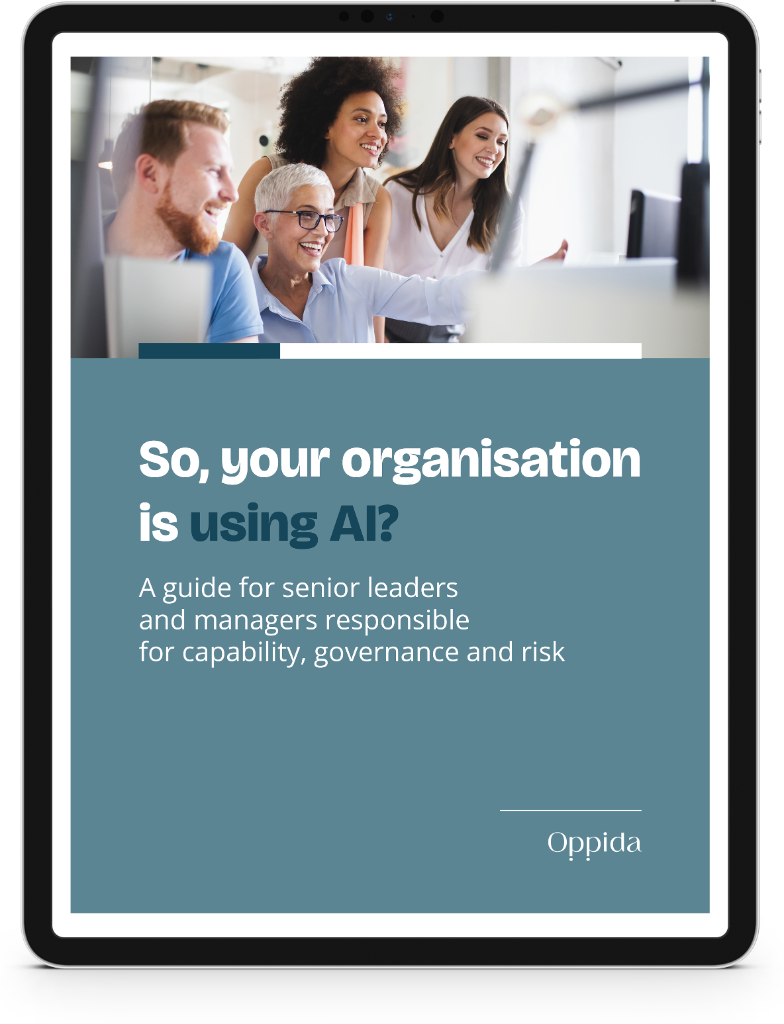
Get the free guide
Download the guide to understand what AI governance now requires from leaders.

"AI won't replace humans. But humans who use AI will replace those who don't."
Sam Altman, CEO, OpenAI
A quick reality check
If an AI-assisted document were examined by an auditor or regulator today, could you explain:
If not — this guide is for you.
Why this matters now
AI adoption happens gradually, then becomes a governance issue.
Staff increasingly use AI to draft documents, summarise information, and analyse data.
Over time, these outputs begin to shape recommendations and decisions.
At that point, AI is no longer just a productivity tool.
It becomes part of the organisation's decision-making infrastructure, and therefore a governance issue.
That is what regulators ultimately care about: not the tools themselves, but whether the decisions they influence are robust, consistent, and defensible.
This is why AI literacy matters.
Using AI regularly does not mean people understand how its outputs are produced or when they should be questioned.
AI literacy is about judgement, not just tool use.
The governance challenge
Governance depends on shared capability
AI governance ultimately depends not only on rules, but on the capability and judgement of the people applying them.
Across many organisations, three dynamics are already emerging.
AI is already embedded
Staff are using AI tools to draft advice, analyse information, and prepare documentation, whether or not a formal strategy is in place.
Practice varies across teams
Without shared standards, teams develop different habits around verification and judgement, making consistent oversight difficult.
Accountability remains human
When AI-assisted work contains errors or omissions, responsibility still sits with the professionals who relied on it, and the organisation within which it was used.

"At a time when information environments are already saturated and fast-moving, this shift increases both opportunity and risk. Without shared understanding, organisations may rely on tools without fully appreciating their limitations. Over time, that can weaken consistency, accountability and professional standards. For this reason, I believe AI literacy must be understood as a governance capability."
Bianca Raby, Founder & CEO, Oppida
Inside the guide
Unpacking the governance challenge
This guide distils the governance implications of AI adoption into five short chapters.
AI decisions are now part of your governance remit
Accountability remains human
Understanding the need for policy and guidelines
Shared capability as the foundation of governance
From governance challenge to practical implementation
Download the guide to understand what AI governance now requires from leaders
Download the free guide →Written for senior leaders and managers responsible for capability, governance and risk
Government & public sector
- Workforce capability leaders
- Digital capability teams
- Governance and ethics managers
Education providers
- Directors of teaching and learning
- Quality and compliance leaders
- Professional learning teams
Health & human services
- Workforce development leaders
- Clinical governance teams
- Quality and safety leaders
About the author
Bianca Raby
Founder, Oppida
Bianca Raby is the founder of Oppida and a recognised leader in digital transformation and AI literacy in education and workforce development.
Her work focuses on helping organisations build the knowledge, judgement, and capability required to navigate complex technological change responsibly.